
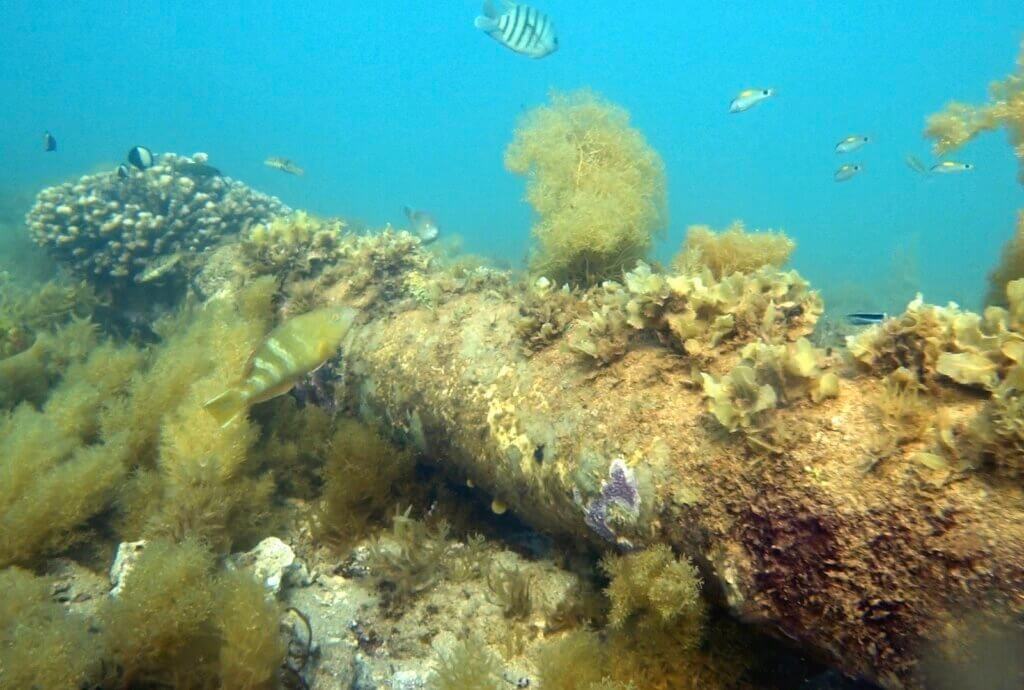
Image credit: Dr Alethea Madgett
Exposure to the subsea environment gradually degrades pipelines, which are typically made of carbon steel coated with concrete or polymer. Hydrocarbon production can result in the buildup of scale deposits composed of organic wax, heavy metals, and Naturally Occurring Radioactive Materials (NORM). INSITEs Phase 3 project: CoRRODE aims to advance the understanding of the medium-term and long-term degradation mechanisms of left-in-place decommissioned subsea pipelines.
The project focuses on both the breakdown and dispersal of physical particles from rigid pipelines and the mobilisation and environmental fate of contaminants found within the pipeline scale.
The vision of CoRRODE is to generate robust, quantitative insights that can inform predictive modelling and environmental assessments related to pipeline degradation and dispersal of breakdown particles. The focus lies on the pipeline material and its surrounding environment, providing a scope for high-resolution analysis to support more informed and effective decommissioning strategies.
The approach to this research will include:
Building on novel research, CoRRODE will address key knowledge gaps, such as the limited integration of corrosion kinetics into dynamic contaminant release modelling and the lack of knowledge concerning the size distribution of subsea pipeline breakdown particles.
The project will utilise a purpose-designed and built erosion–corrosion experimental rig to quantify post-decommissioning corrosion rates and particle properties. Furthermore, it will adapt a novel risk assessment approach, originally developed for cuttings piles, to test at a pipeline scale to determine both total and reactive contaminant concentrations, increasing environmental relevance. The results will feed directly into the development of a time-dependent reliability model to enable long-term estimates of degradation and particle dispersal and associated risk.
The anticipated findings from this project will inform decision-making on pipeline decommissioning projects by operators and bear importance for regulators and policymakers. The outcomes will offer tangible value by supplying evidence-based input for Environmental Impact Assessments (EIAs) and contributing to the evolution of Best Available Techniques. By reducing knowledge gaps, CoRRODE will provide evidence that can directly feed into Comparative Assessment processes.
CoRRODE findings will be disseminated through webinars, peer-reviewed publications, and Lunch and Learn stakeholder workshops held every 6 months.
Follow the INSITE programme on social media and check the National Decommissioning Centre and University of Aberdeen news sections for updates on key findings and their implications for offshore decommissioning.
VALMAS The transition to NetZero is driving rapid growth in Marine Artificial Structures (MAS), alongside...

Introducing READ-ME Through evidence synthesis, robust social science, advanced stakeholder engagement and immersive 3D visualisation,...
We regularly publish updates on the projects that are directly funded by the Programme and other related research. If you would like to be kept up to date, sign up for our Connections newsletter.